Ultrarunning Doubled in a Decade. Here's Who's Running.
Tags: ultra running, statistics, demographics, women in ultrarunning, trail running growth, first ultra
by HARDN
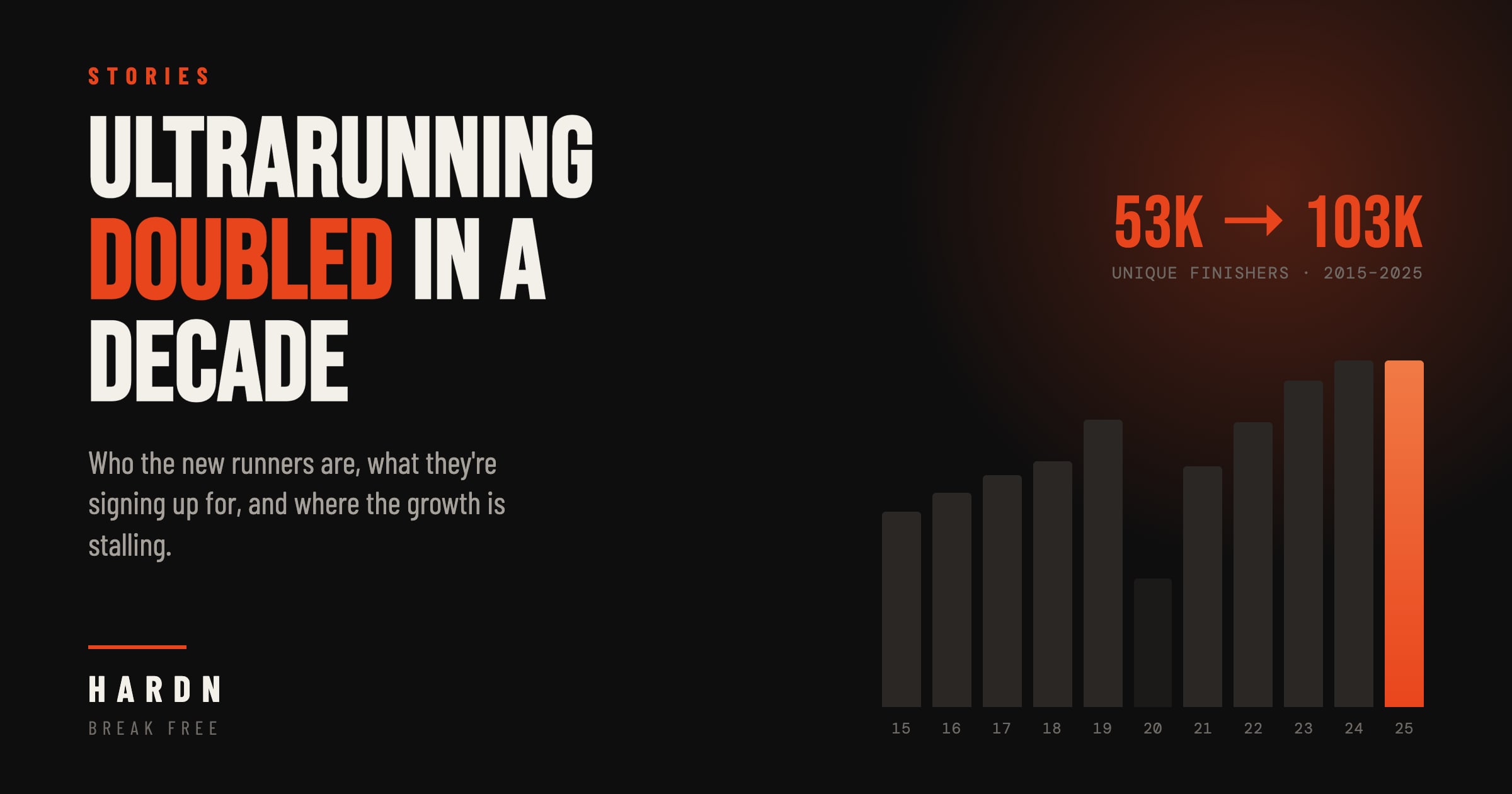
Ten years ago about 53,000 people finished an ultramarathon in North America. Last year it was nearly 103,000.
The sport roughly doubled in a decade. But the headline hides the more interesting part: who those new runners are, what they're signing up for, and where the growth is quietly stalling.
Most of the numbers below come from UltraRunning Magazine's results database, which tracks every North American ultra finish back to 2000. The demographic detail comes from RunSignup's 2025 ultramarathon report, which covers about 50,000 runners across 728 events.
A decade in numbers
Compare 2015 with 2025:
- Unique finishers: 53,261 to 102,812. Up 93 percent.
- Total finishes: 92,073 to 152,564. Up 66 percent.
- Races held: 1,652 to 3,275. Almost exactly doubled.
- First-time finishers: 22,965 to 42,266. Up 84 percent.
Zoom out further and it looks less like growth and more like a different sport. In 2000 there were 8,432 unique finishers. Today there are twelve times as many.
Ultras are also growing a little faster than racing overall. RunSignup saw ultra registrations rise 6.4 percent from 2024 to 2025, against 5 percent for every distance on its platform.
The 2020 hole, and the climb out
Then the races stopped.
Finishes went from 130,321 in 2019 to 46,932 in 2020, a drop of 64 percent. Half the calendar vanished.
The recovery took three years. Finishes didn't pass the 2019 number until 2023. Then 2024 added more than 11,000 unique runners in a single year, the largest gain outside the post-pandemic rebound.
2025 was flatter. Unique finishers grew 2.6 percent. That's one year, and one year doesn't make a trend, but it's worth watching. The decade's growth wasn't a smooth line. It came in surges.
More races, smaller fields
The number of races doubled. The number of runners in each one shrank.
In 2015 the average race had 56 finishers. In 2025 it had 47. Back in 2013 it was 61.
That's not a sign of weakness. It's what a growing sport looks like when the growth happens on the edges: a new 50K in a state park, a backyard ultra on someone's farm, a 12-hour loop around a local trail. The big-name races are capped and lottery-bound. The new runners are going somewhere else.
People are racing fewer ultras each
In 2015 the average finisher completed 1.73 ultras that year. In 2025 it was 1.48.
Part of that is simply who's arriving. Four in ten finishers last year were finishing their first ultra. A first-timer runs one race, maybe two. The sport isn't only getting bigger. It's getting newer.
That's the real story. More than 42,000 people finished their first ultra last year. Every one of them had to figure out a training plan, a fueling plan, cutoffs, drop bags and a crew, mostly from forum posts and friends.
Who's running
Age: mostly 30s and 40s
From RunSignup's 2025 data:
- Under 30: about 18 percent
- 30 to 39: 29 percent
- 40 to 49: 26 percent
- 50 to 59: 15 percent
- 60 and up: about 6 percent
More than half the field is between 30 and 49. That's the opposite of most sports, where the peak participation years come early. Ultrarunning is something people find in midlife, often after years of road running, sometimes after something harder.
The patience it takes, the willingness to hurt for a long time, the ability to keep going when nothing about it is fun: those tend to come with age. So does the money and the time off.
Women: the share has stalled
Women made up 23.7 percent of finishes in 2000. That rose steadily for almost two decades, peaking at 33.8 percent in 2018.
Since then it has drifted back down. 31.5 percent in 2025. Just under 31 percent so far in 2026.
In absolute numbers women's participation is still growing fast, from roughly 30,000 finishes in 2015 to roughly 48,000 last year. But men's grew faster, so the share went backwards. After twenty years of steady progress, the gap is no longer closing.
Women's share falls as the distance rises
RunSignup's 2025 numbers by distance:
- 50K: 34 percent women
- 50 mile: 27 percent
- 100K: 29 percent
- 100 mile: 24 percent
Then the pattern breaks. In timed races, where you run as far as you can in a fixed window, women make up 44 percent of 6-hour fields, 44 percent of 12-hour fields and 46 percent of 24-hour fields. Close to even.
The data doesn't tell us why. Timed formats are usually loops, close to an aid station, with no cutoffs to miss and no mountain to get stuck on in the dark. Every lap is a finish. Whatever the reason, it's the strongest hint in the numbers about what might bring the 100-mile share back up.
What they're signing up for
The 50K is the sport's front door. It accounts for 42 percent of ultra participants. The 100-mile accounts for about 11 percent.
Formats that barely existed a decade ago are now a real slice of the calendar. Backyard ultras are 3 percent of events and grew 17 percent last year. Timed and odd-distance races grew faster still. RunSignup cautions that single-distance samples are small, so take the individual percentages lightly. The direction is clear.
Ultras are a commitment
A few numbers that show how different an ultra is from a weekend 10K:
- Signing up early: 44 percent of ultra runners register more than four months out. For races overall it's 9 percent.
- Travel: Almost half of 50K runners live within 50 miles of the start. Almost half of 100-mile runners travel more than 200 miles.
- Cost: The average entry fee is about $117 for a 50K and $287 for a 100-miler, before travel, gear and a crew.
- Season: October is the busiest month. Texas, Colorado, California and Utah host the most races.
Most people don't drift into a 100-miler. They pick it months ahead, pay for it, travel to it, and build a year around it.
The trail boom underneath it
Ultras grow out of a much larger base. The Outdoor Industry Association counted 17.2 million trail runners in the US in 2025, up 57 percent since 2019. Most of them will never run an ultra. But that base is where the 50K first-timers come from, and it's still growing.
The short version
North American ultrarunning has roughly doubled in a decade, to about 103,000 finishers and 3,275 races a year. Growth came in surges, with a deep hole in 2020 and a big surge in 2024.
The field is mostly 30 to 49. Four in ten finishers are first-timers. Women's share climbed for twenty years and has slipped since 2018, and it falls further the longer the race gets, except in timed formats, where it's close to even.
The sport is getting bigger, newer and more spread out. Smaller races, more of them, more people doing it for the first time.
Every one of those 42,000 first-timers stood at a start line not fully sure they could finish. Most of them did.
Sources: UltraRunning Magazine results database (North American races, ultrarunning.com); RunSignup, 2025 Ultramarathon Statistics; Outdoor Industry Association, 2026 Running Report.
Break free.