The Longer You Do This, the Less It's About You
Tags: why we run, ultra running, psychology, motivation, community, runner's high, break free
by HARDN
Everybody gets asked the same question at some point. Usually by someone at work, usually in the same tone they'd use to ask about a gambling problem. Why would you run that far?
The answers we give are terrible. Because it's there. Because I like the mountains. Because I'm an idiot. We say something that ends the conversation, because the real answer is harder to say out loud and we're not sure we know it.
Turns out people have studied this. Not many, and not always well, but enough to say something real. And what they found doesn't match the story the sport tells about itself.
The longer you do this, the less it's about winning
The biggest study put 1,539 runners through the Motivations of Marathoners Scale, a standard questionnaire that breaks down why people run into nine separate motives. 425 of them had finished at least one ultra. The rest ran shorter.
The ultrarunners scored higher on two things: affiliation, meaning running with other people, and life meaning. They scored lower on weight concern, and lower on running for self-esteem.
Those gaps are small. We're talking 4.20 against 4.03 on a seven-point scale for life meaning. Across fifteen hundred people it's a real difference, but it's not a canyon, and anyone telling you ultrarunners are a different species is overselling it.
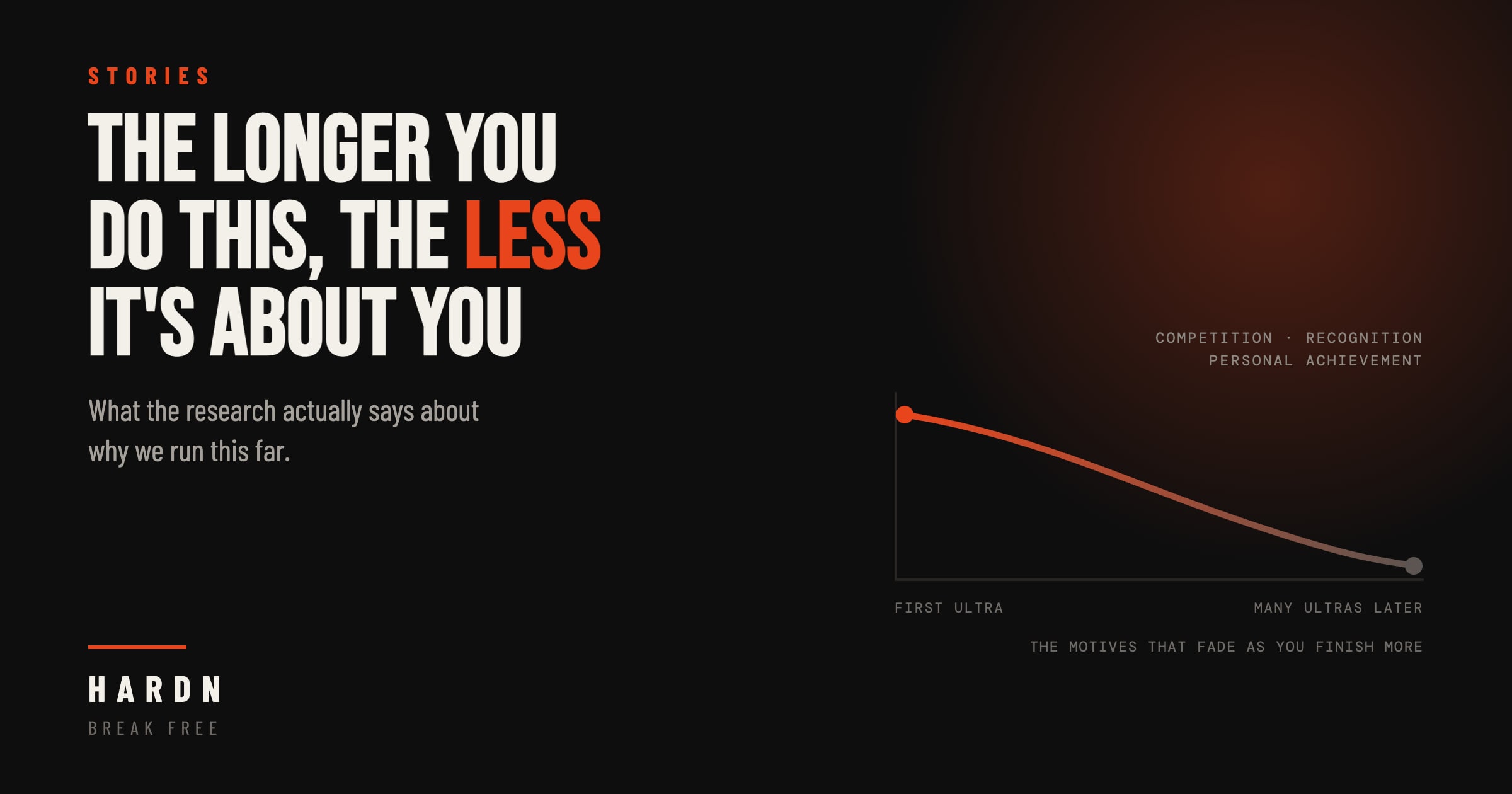
The finding worth sitting with is a different one. Among the ultrarunners, the number of ultras someone had finished was negatively correlated with three things: personal goal achievement, competition, and recognition.
Read that again. The more of these you've done, the less you're doing it to achieve something, beat someone, or be seen.
Experience doesn't sharpen the competitive edge. It wears it down. Whatever brings people to their first 50K, it isn't what keeps them coming back at race forty.
What's left when the achievement burns off
In 2014 a sport psychologist interviewed 26 ultrarunners from the UK, the US and Canada. Seven women, nineteen men, ages 32 to 67. Some had done one 50-miler. Some had done over a hundred races.
Four themes came out of those interviews. Preparation. Managing yourself during the race. Discovery and personal achievement. And one that came up more than any other.
Community.
Not as a nice-to-have. As the dominant feature of the entire experience. And the researchers found something specific about it that's worth saying plainly, because it's unusual:
In most sport communities, you're accepted on the basis of how good you are. In this one, ability, gender, experience and success were not criteria for acceptance. Runners valued each other for being willing to take part. That was the whole entrance requirement.
The same runners singled out crews and volunteers as essential to the sport existing at all. A sport whose participants consider the people who don't run it to be central to it.
Anyone who has been handed a cup of broth at 2 AM by a stranger who's been standing in the cold for six hours knows this already. It's just rare to see it show up as the number one finding in a peer-reviewed study.
We don't feel less pain. We flinch less.
Here's where it gets genuinely interesting.
Researchers took 20 ultrarunners and 20 matched non-runners and ran a cold pressor test on them, which means a hand in near-freezing water until you can't take it. The ultrarunners lasted significantly longer. No surprise.
The surprise is why. The analysis found that reduced pain-related escape and avoidance behavior accounted for 40 percent of the difference. The ultrarunners also scored lower on pain anxiety across the board.
It isn't that we feel less. It's that we don't flinch away from what we feel. The sensation arrives and we don't immediately try to make it stop.
An earlier study found the same tolerance in eleven runners from the TransEurope FootRace, a 2,789-mile race run over 64 days with no rest days. Their cold pressor results against matched controls weren't close. The authors were careful to say they couldn't tell which direction it runs: does a high pain tolerance make you an ultrarunner, or does ultrarunning build it? Nobody knows yet.
But the mechanism matters more than the direction. If the thing separating us is a relationship to discomfort rather than a nerve ending, then it's not a gift. It's a practice. Which is what every runner who's worked through a bad patch at mile 70 already suspected.
That's what the pain cave actually is. Not a higher threshold. A decision, made over and over, not to run from the thing that hurts.
The runner's high is real. It's not endorphins.
Every running article written in the last forty years credits endorphins. It's one of those facts everyone knows.
It appears to be wrong.
Researchers gave 63 people either naltrexone, a drug that blocks opioid receptors, or a placebo. Double-blind, randomized. Then they had them run for 45 minutes.
Euphoria went up. Anxiety went down. Blocking the opioid system didn't prevent any of it. The same proportion of people reported a runner's high on the blocker as on the placebo.
What did rise were endocannabinoids, anandamide and 2-AG. The same receptor system cannabis works on. An earlier mouse study found the same thing: block the cannabinoid receptors and the runner's high disappears, block the opioids and it doesn't.
Your body isn't making its own morphine out there. It's making its own cannabinoids. Forty years of race-morning small talk, slightly wrong.
Born to run, with an asterisk
The evolutionary argument gets quoted at every start line. In 2004, two researchers published a paper in Nature arguing that endurance running is a derived capability of our genus, roughly two million years old, and may have shaped the human body into what it is. Humans are mediocre sprinters and remarkable distance athletes.
It's good science and it's the wrong answer to this question.
It explains capacity, not motivation. Being built to cover ground on foot doesn't explain why a person with a mortgage and a desk job signs up for Hardrock. Plenty of people are equally well-built for it and have no interest whatsoever. They're not broken. They're just not doing this.
Use it to explain how we can. Don't use it to explain why we do.
The ones running to get sober
This sport tells one story about itself more than any other. That people out here are running from something. Addiction. Grief. A version of themselves they didn't want to be anymore.
That story is true, and the research on it is better than you'd think. It's just small, and what it actually found isn't what the story usually claims.
Start with the obvious thing: coping has been one of the nine measured motives for running since 1993, when the Motivations of Marathoners Scale was built. Psychological coping sits on the same questionnaire as competition and recognition. Researchers have been counting it for thirty years.
Worth noticing what the big study above didn't report, though. It named five motives that differed significantly between ultrarunners and shorter-distance runners, and psychological coping wasn't among them. Coping is a real reason people run. On that evidence it isn't the thing that makes someone run far.
Where ultra distance does show up by name is in the work on addiction.
One study followed eleven people in recovery who had become regular runners, interviewing them while they ran their usual routes. The finding wasn't that running burned the craving off. It was that running gave them a structure. A shape for the day. A reason to sleep. A body they were back in contact with. Something organized, set against the disorganization that addiction had left behind. Recovery was nonlinear and they said so. People relapsed and came back. The running held the shape while they did.
A narrative study of two ultrarunners' memoirs found the same thing in different language: a shift out of a chaos story, being an addict who runs, and into a quest story, becoming an ultrarunner. The running didn't fix anything directly. It gave them a different person to be.
An ethnography of young men coming off narcotics put it more bluntly still, describing the ultra effort as producing an altered state that resembled what they had been chasing chemically.
So the honest version is better than the cliché. It isn't about outrunning the pain. It's about trading one organizing structure for another and getting an identity in the deal. Which, if you look back up this page, is the same mechanism as the rest of it. Structure, community, a person to become.
Two limits worth stating. These studies have samples of two, six, eleven. They describe experience; none of them shows that running causes recovery, and the researchers are careful to say so. And nobody has measured how common any of this is. We know it happens and roughly how it works. We have no idea how many of us.
Grief is thinner ground. A 2021 systematic review found that physical activity helps bereaved people, with running among the things that helped, but no evidence that running does more than any other activity. If you ran through a loss and it held you together, that was real. It just doesn't appear to be special to this sport. Our own piece on why I run is that story, and it's true without a study behind it.
The part that doesn't flatter us
An honest post has to include this too.
When researchers measured exercise dependence across race distances, the scores climbed in a straight line with the distance. Recreational runners at 2.16. 5K runners at 2.9. Marathoners at 3.78. Fifty-mile ultrarunners at 4.59, significantly higher than the marathoners. The study is from 1993 and it isn't large, but that gradient is hard to look away from.
Some of what looks like devotion is dependence. Not for everyone, and not always, but the sport's tendency to treat every excess as a virtue makes it hard to notice when someone has crossed over. The person who won't take a rest day, who races hurt, who gets unbearable when they can't run. We call that commitment. Sometimes it is.
The runners in that recovery study knew this better than anyone. Several of them named the risk themselves: that the thing which got them out might turn into the next thing they couldn't stop. They had been here before. They knew the shape of it.
If running is the structure holding your week together, that's worth something. It's also worth asking, once in a while, what happens on the days you can't.
So why do we do it
Put the findings in a line and they point somewhere.
The achievement motives fade with experience. Competition and recognition fade with experience. Community turns out to be the strongest feature of the whole thing, in a community that admits you for showing up rather than for being fast. The pain thing isn't toughness, it's the practice of not running away. And the chemical reward is quieter and stranger than the one we've been naming.
Which means the honest answer to the question at work is something like this:
The longer you do this, the less it's about you.
You start because you want to see if you can. That's fine. That's how everyone starts. But that reason has a shelf life, and at some point it stops being enough to get you out of bed at 4 AM in February.
What replaces it is smaller and harder to explain. The people. The hours where nothing hurts yet and the light is coming up. The fact that you can be bad at this and still belong. Learning that pain is information rather than an emergency, and carrying that back into a life where most things that hurt aren't emergencies either.
One of the runners in that 2014 study called it a voyage "into the unknown about yourself."
That's closer than anything we usually say at work.
The short version
Ultrarunners are motivated more by affiliation and life meaning than shorter-distance runners, and less by weight and self-esteem. The more ultras you finish, the less you care about achievement, competition and recognition.
Community is the single most prominent theme in the qualitative research, and it's a community that accepts you for starting rather than for finishing well.
We don't have higher pain thresholds. We have less pain-related avoidance, which is a learnable thing. The runner's high runs on endocannabinoids, not endorphins. The evolution argument explains capacity, not desire.
People really do run their way out of addiction, and the small qualitative literature says it works by giving them a structure and an identity rather than by burning off the craving. Nobody has measured how common that is. And exercise dependence climbs with distance, which is worth watching in yourself.
You didn't start for the reasons you keep going. Almost nobody does.
Sources: Waśkiewicz et al., Motivation in ultra-marathon runners, Psychology Research and Behavior Management 2019; Simpson, Post, Young and Jensen, "It's not about taking the easy road": The experiences of ultramarathon runners, The Sport Psychologist 2014; Roebuck et al., Psychological factors associated with ultramarathon runners' supranormal pain tolerance, The Journal of Pain 2018; Freund et al., Ultra-marathon runners are different, Pain Practice 2013; Siebers et al., Exercise-induced euphoria and anxiolysis do not depend on endogenous opioids in humans, Psychoneuroendocrinology 2021; Fuss et al., A runner's high depends on cannabinoid receptors in mice, PNAS 2015; Bramble and Lieberman, Endurance running and the evolution of Homo, Nature 2004; Pierce, McGowan and Lynn, Exercise dependence in relation to competitive orientation of runners, Journal of Sports Medicine and Physical Fitness 1993; Bogue Kerr et al., Running and Stumbling to Recovery; McGannon, L'Estrange and McMahon, The role of ultrarunning in drug and alcohol addiction recovery, Psychology of Sport and Exercise 2020; Cecale, "It Hurts Good": Ethical Highs, From Addiction to Ultramarathon Running, Ethos 2020; Williams et al., Can physical activity support grief outcomes in individuals who have been bereaved?, Sports Medicine - Open 2021; Masters, Ogles and Jolton, The development of an instrument to measure motivation for marathon running (MOMS), Research Quarterly for Exercise and Sport 1993.
Break free.