Runner's Knee: It's a Load Problem, Not a Knee Problem
Tags: runner's knee, patellofemoral pain, injury prevention, strength training, downhill running, ultra running
by HARDN
Runner's knee doesn't tear. It doesn't pop. It just quietly makes the downhills unbearable, and downhills are most of what an ultra is.
It's the most common running injury there is. A systematic review pooling the literature through 2020 found patellofemoral pain in 16.7 percent of injured runners, a larger share than any other diagnosis. In the same review's ultramarathon group it was the second most common injury by incidence, at 15.8 percent, and the knee was the second most injured part of an ultrarunner, behind only the ankle.
The name makes it sound like the knee broke. It didn't. This is a load problem, and the knee is just where you feel it.
What it actually is
Patellofemoral pain is pain where your kneecap meets your thigh bone. The kneecap rides in a groove at the end of the femur, and your quad pulls it hard into that groove every time the knee bends under load. The deeper the bend and the harder the quad pulls, the more force goes through that joint.
Nothing is torn. Nothing is out of place. The joint is being asked to absorb more than it currently tolerates, more often than it can recover from. That's the whole mechanism, and it's also the reason it responds to changing the load rather than to fixing a flaw.
It feels like:
- A dull ache around or behind the kneecap. Hard to point at with one finger.
- Worse going downhill, worse down stairs, worse in a deep squat.
- Stiff and sore after sitting a long time. Physios call it the movie sign. You feel it after a long drive to a trailhead.
- Fine for the first few miles, then building. Often worse the day after a long descent than during it.
Make sure it's this
Three other things get called runner's knee and want different treatment:
- Pain on the outside of the knee, a sharp or burning line, often coming on at a predictable point in a run: more likely IT band syndrome.
- Pain right below the kneecap, on the tendon, that you can press with one finger and that warms up rather than builds: more likely patellar tendinopathy.
- Pain you can cover with a fingertip on the bone, that hurts when you hop, that aches at rest or wakes you up: that's a bone stress injury until proven otherwise, and it is the one you do not train through.
Stop and get it looked at if the knee locks, gives way, swells enough to look visibly bigger, or hurts at night. Those aren't load problems.
Why it happens
1. You added load faster than the joint adapted
This is the big one and it's boring. A jump in weekly mileage. A jump in vert. A new race on the calendar that moved the long run from 3 hours to 5. Back-to-back big weekends. A training block that went from rolling dirt to real mountains.
Tissue adapts to load, but on its own timeline, and the knee's timeline is slower than your enthusiasm. Almost every runner's knee story has a ramp in it somewhere in the four to eight weeks before the pain showed up. Go look at your log.
2. Downhill
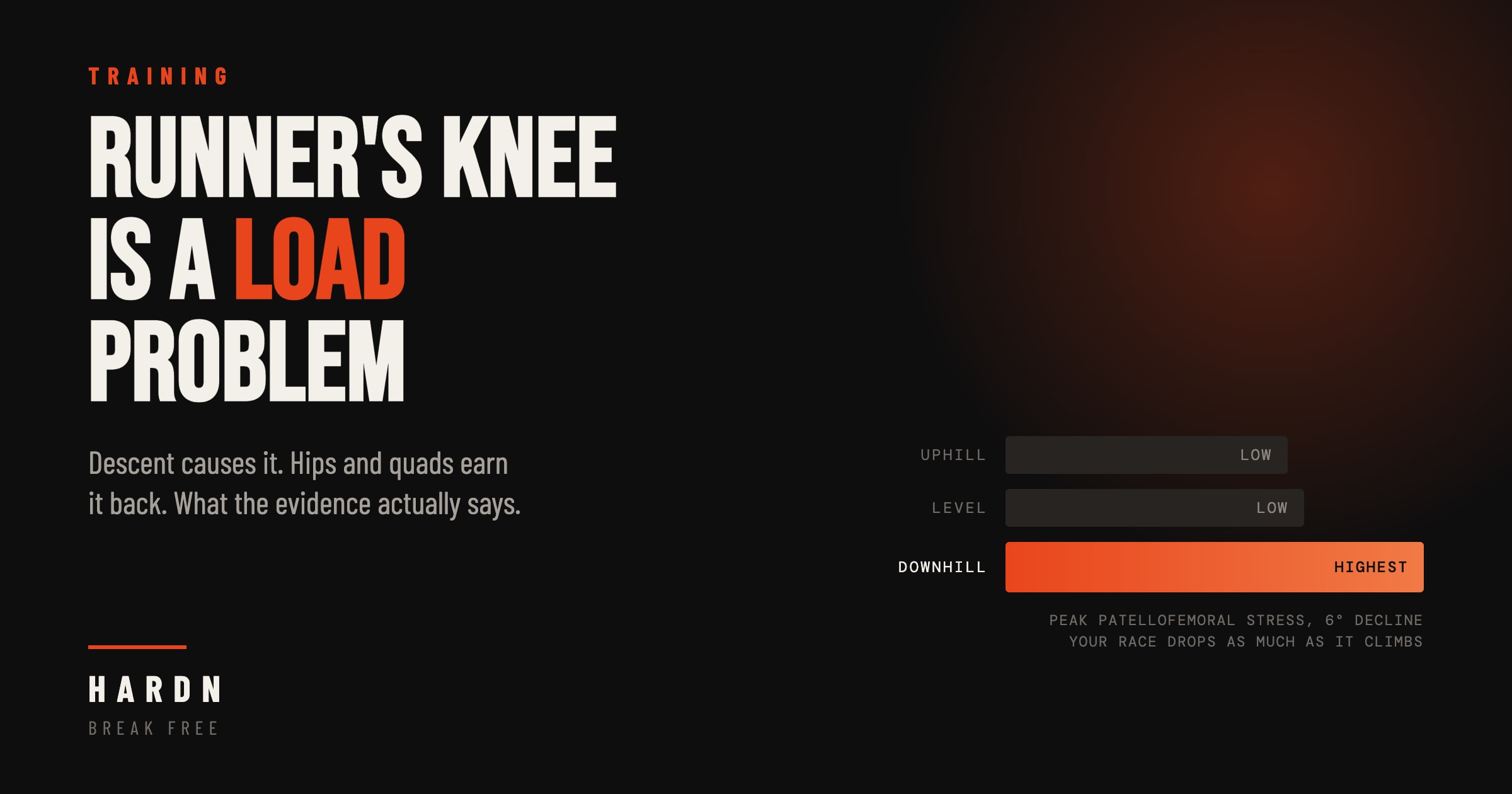
Downhill is where this injury lives. When researchers put runners on a 6-degree decline, peak patellofemoral stress was higher than on level ground and higher than running uphill. Level and uphill were about the same as each other. The decline was the outlier.
The reason: going down, your quad works as a brake. It fires hard with the knee bent to stop you collapsing on every step, and that braking force is what loads the kneecap. Uphill the knee bends plenty, but the quad is shortening and pushing rather than lengthening and resisting.
So a 100-miler with 20,000 feet of gain also has 20,000 feet of loss, and that second number is the one your kneecap cares about. Most training plans count the climb and ignore the descent.
3. Stride length and cadence
A long stride lands your foot further in front of your body with a straighter leg, and that puts a bigger braking force through a joint that has less room to absorb it. Overstriding and a slow cadence show up over and over in runners with this.
4. Hip control, honestly
You'll be told runner's knee is caused by weak glutes letting the knee fall inward. That story is half right and it's worth knowing which half.
Runners who have patellofemoral pain do measure weaker at the hip than runners who don't. But a systematic review of the prospective studies, the ones that measure people before they get hurt and follow them, found no association between hip strength and the risk of developing it. The weakness looks more like a consequence of the pain than its cause.
That doesn't make hip work pointless. The best evidence we have says to do it. It means you should stop treating weak glutes as the diagnosis and your personal failing, and start treating strength as capacity you're building for the load ahead.
5. Not enough quad for the job
Your quads are the brake on every descent of your race. A 100-mile day is tens of thousands of eccentric contractions, and the knee's tolerance for that is trainable. Runners who only run have no stimulus for it beyond the running itself, which is exactly the load that's already hurting.
What actually works
Here's the part that surprised a lot of people, us included.
A trial put 69 runners with patellofemoral pain into three 8-week programs: education and load management alone, education plus exercise, or education plus gait retraining. All three groups got better. Adding the exercises or the gait retraining produced no extra improvement in pain or function. The exercise group did get stronger and the gait group did change their mechanics. It just didn't show up in how they felt.
The authors' conclusion was blunt: education about symptoms and managing training load should be the primary treatment.
Meanwhile, the 2018 international consensus statement on patellofemoral pain, 41 experts voting on the evidence, recommends exercise therapy, particularly hip-focused and knee-focused exercise combined. It also recommends foot orthoses for short-term pain, says patellofemoral and lumbar mobilisations alone and electrophysical agents are not recommended, and lists gait retraining, taping and bracing, and dry needling as uncertain.
Put those two together and you get the honest version: managing the load is what fixes the pain. The strength work is what lets you take the load back. Do both. Expect the load changes to be what you feel first.
The load rules
You don't have to stop running. You do have to stop doing the thing that hurts it.
- Cut the descent first, not the mileage. Flat and rolling, same hours, far less damage. Walk the steep downs if you have to. If you have a treadmill or a road climb, climbing is the cheapest aerobic work you can do with this.
- Shorten the stride. Especially going down. Quick, small steps, land under yourself.
- Use a pain scale and respect it. Up to about 3 out of 10 during a run is workable. It has to be back to baseline within 24 hours, and the next morning can't be worse than the last one. If it is, you went too far. That's the rule, not how it felt at the time.
- Change one thing a week. Hours, vert, or intensity. Not all three.
- Give it 6 to 12 weeks. This is a slow injury. Two good weeks is not recovery.
HARDN's training load numbers are built for exactly this. A knee that started hurting in week five of a block usually has a visible acute ramp behind it, and a chronic load that never caught up. Our piece on CTL, ATL and TSB covers how to read it. Log descent, not just gain, and the ramp stops being invisible.
The exercises
Combined hip and knee, which is what the consensus asks for. Two or three sessions a week, 12 weeks, and heavy enough that the last couple of reps are genuinely hard. Easy sets of 20 are not a stimulus.
Rule for all of it: work in the range that doesn't hurt. Pain up to about 3 out of 10 is acceptable, sharp pain is not, and a joint that's angrier the next morning means you did too much.
First: calm it down
Spanish squat or wall sit. Band around the back of the knees anchored in front of you, or back against a wall, shins vertical, hold around 60 degrees of knee bend. Five holds of 45 seconds, 1 to 2 minutes rest. Daily is fine. A heavy quad isometric often takes the edge off the pain for hours afterward, which makes the rest of your day and the rest of this list possible.
Isometric quad set. If even that hurts, start with the leg straight: squeeze the quad hard for 10 seconds, 10 times, a few times a day. Low bar, but it's a start that isn't nothing.
Knee-focused
- Leg press or box squat, to a depth that doesn't hurt. Shallow and heavy beats deep and painful. 3 or 4 sets of 8 to 10, adding load weekly. Pain usually lives in deep flexion, so cut the depth and keep the load.
- Step-downs. Stand on a box, lower the other heel toward the floor slowly over 3 seconds, tap, come back up. Start on a 4-inch box, work toward 8 inches. 3 sets of 8 each side. This is the single most honest test of whether your descent is improving.
- Split squat or reverse lunge. Single-leg strength under real load, and the hip has to control the knee's position while it happens. 3 sets of 8 each side, holding weight once bodyweight is easy.
- Leg extension, partial range. Worth it if you have the machine. Work from 45 degrees to straight at first, which keeps the kneecap off the painful part of the groove, and open the range up as it settles.
- Calf raises, slow down. Both legs then one, 3 sets of 12, lowering over 3 seconds. Your calves share the braking on every descent, and when they fail the quad eats the difference.
Hip-focused
- Side-lying hip abduction. Bottom leg bent, top leg straight and slightly behind the line of your body, toes level or turned slightly down. Lift about 30 degrees, slow, no rolling backward. 3 sets of 12 to 15 each side, ankle weight once it's easy.
- Side plank with top-leg lift. Forearm and knees to start, feet when you're ready. Hold 30 to 45 seconds, lifting the top leg. 3 each side.
- Banded lateral walks. Band above the knees, quarter squat, 15 steps out and 15 back, feet never together. 3 rounds. Should burn in the side of the hip, not the front of the thigh.
- Single-leg bridge or hip thrust. Glutes for extension, which is what drives you up a climb. 3 sets of 10 each side, loaded once you can do that cleanly.
- Copenhagen plank. Side plank with the top foot on a bench or chair, lifting the bottom leg to meet it. Hard, and the adductors are part of controlling the knee. Start with the top knee on the bench. 3 holds of 20 seconds each side.
Running form, carefully
The consensus calls the evidence for gait retraining uncertain, so treat this as a lever rather than a cure. But the mechanics are measurable. Running at 110 percent of preferred step rate cut peak patellofemoral joint force by about 14 percent in one study, and a 10 percent step-rate increase lowered mean patellar contact pressure by about 10 percent in another.
That's a real reduction in load per step, available for free, today.
- Add 5 to 10 percent to your cadence. Count your steps for 30 seconds, multiply by 2, add 5 to 10 percent, run to a metronome at that number for a few minutes at a time. Don't run faster. Take smaller steps at the same pace.
- Quick feet on descents. Short steps, more of them, let the trail come to you. Not leaning back on your heels, which just makes a longer brake.
- Lean in slightly. A small forward trunk lean from the ankles cuts the knee extensor demand. Sitting upright and back loads the kneecap harder.
The ultra-specific part
Everything above applies to a 10K runner too. Here's what's ours.
Train the descent on purpose. If your race drops 15,000 feet, your knees need to have taken something like that before, in pieces, with recovery between. Downhill repeats are a workout with their own adaptation curve and their own ramp rate. Don't let race day be the first time you've handled real loss.
Poles. Studies of downhill walking with poles put the reduction in knee joint loading in the range of roughly 10 to 20 percent. The figures vary by study and setup, and they're from walking rather than running, so don't expect precision. But for a long descent at hiking speed, it's one of the few things that takes load off the joint without taking time off your day. Our pole guide covers what to carry.
Plan the race around it. If you know your knee is the limiter, the big descent at mile 70 is the part to walk from the top, early, before it hurts, not after. Same logic as stopping at a hot spot before it's a blister. The cheap moment always comes before the expensive one.
Watch the taper and the week after. Pain that shows up in a taper is usually the bill for the three weeks before it. Pain that shows up in the first week back after a race is a joint that hasn't finished recovering, not a new injury.
Getting back to running
When the step-downs stop hurting and stairs feel normal, start here:
- Flat, easy, 20 to 30 minutes. Run-walk if you need to. Judge it by the next morning, not by the run.
- Same thing three times in a week with no next-morning flare, then add 10 to 15 percent of time.
- Reintroduce climbing before descending. Climb and walk down, or climb a treadmill.
- Then short, gentle descents. Quick feet. Add a little each week.
- Steep and long descents last, and the first one shorter than you think it needs to be.
- Keep the strength work going the whole time, and after. It's the thing holding the new ceiling up.
When to go see someone
Get it assessed if the pain hasn't moved in 6 to 8 weeks of doing this properly, if it's getting worse while you're backing off, or if you've got any of the red flags above: locking, giving way, real swelling, night pain, or a spot on the bone you can cover with a fingertip. A physio who treats runners is worth more than another month of guessing.
The short version
Runner's knee is the kneecap joint being loaded more than it currently tolerates. It's the most prevalent running injury there is, and the knee is the second most injured part of an ultrarunner.
Descent is the load that causes it. Find the ramp in your log. Cut the downhill, shorten the stride, use the 24-hour rule, and give it 6 to 12 weeks.
Build the hip and the knee together, heavy enough to count, for 12 weeks. Isometrics when it's angry. Step-downs as the test. Poles and quick feet on race day.
Your knee isn't broken. It's undertrained for what you asked it to do. Those are very different problems, and only one of them has an exercise list.
Sources: Kakouris, Yener and Fong, a systematic review of running-related musculoskeletal injuries in runners, Journal of Sport and Health Science 2021; Collins et al., 2018 consensus statement on exercise therapy and physical interventions for patellofemoral pain, BJSM; Esculier et al., education, exercise and gait retraining trial, BJSM 2018; Rathleff et al., is hip strength a risk factor for patellofemoral pain?, BJSM 2014; Ho et al., patellofemoral joint stress during incline and decline running; Lenhart et al., step rate and patellofemoral joint force, MSSE 2014.
This is general information, not medical advice. A knee that isn't behaving deserves a real assessment.
Break free.